Kyrgyzstan’s Eagle Hunters Preserve an Ancient Cultural Practice
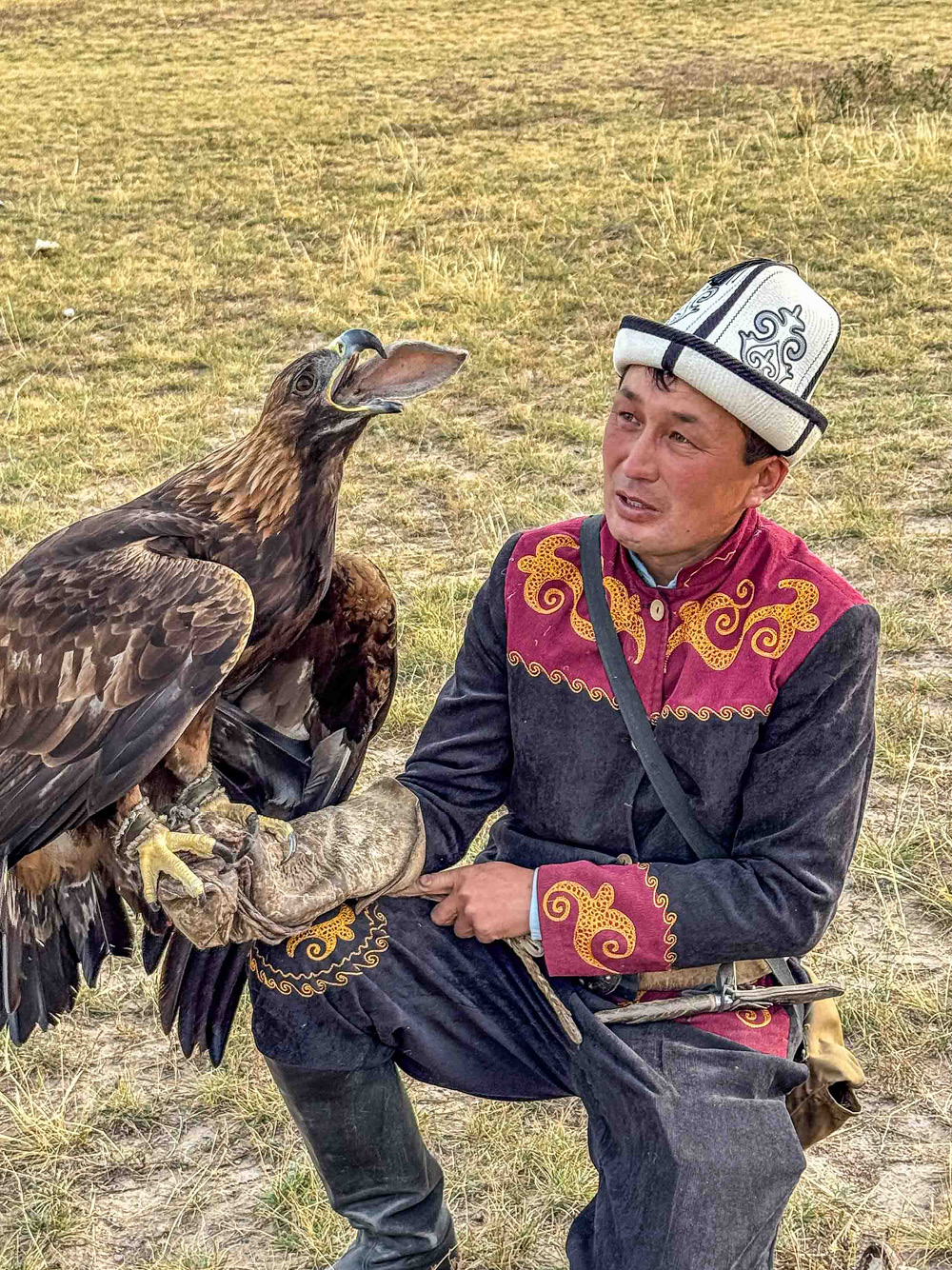
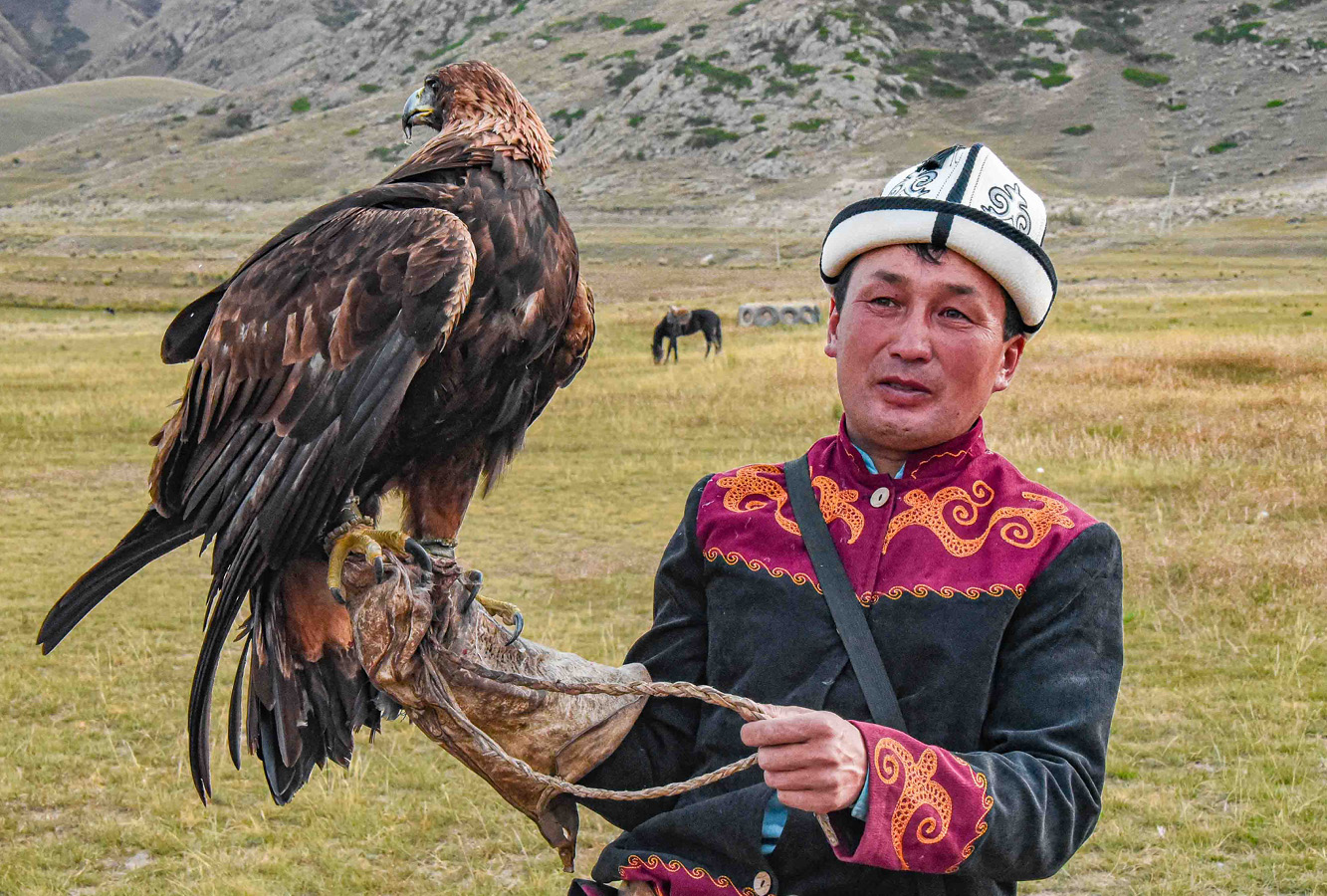
With four-inch razor-sharp talons, she grasps the leather glove that covers the trainer’s hand and forearm. Her large, protruding eyes peer fiercely, as she swivels her head to survey the surrounding landscape in search of movement along the ground. Her prominent curved black beak ends in a sharp hook, useful for piercing, tearing, and shredding fur, flesh, and bones. Golden brown feathers circle her neck, crown and shoulders, while dark chocolate brown plumage covers the rest of this huge raptor. The majestic golden eagle flaps and spreads her wings, showing off her six-and-a-half-foot span.
Four three-inch talons grip the hunter’s leather glove
An ancient custom survives
We’ve come to the south side of Lake Izzyk-Kul in western Kyrgyzstan to visit an eagle hunter and his bird. It’s near the end of a nineteen-day adventure to four of the five countries collectively called the Stans of Central Asia. (For instance, Uzbekistan means land of the Uzbeks.) It’s home to the fabled Silk Road trading routes between China in the East and Rome in the West that flourished beginning more than two thousand years ago through the mid-fifteenth century. Kyrgyzstan sits at an average elevation of 5000 feet. The western end of the China’s Tien Shan mountain range, with its meadows, valleys, lakes, and streams fill most of Kyrgyzstan’s rugged landscape.
For centuries, nomadic families spent winters in the lower elevations, traveling into the mountains’ foothills in warmer weather for food and grazing land for livestock. Nomadic life has all but disappeared, especially during the twentieth century. The Soviets eradicated most of the nomadic communities during the period when this entire region comprised several republics of the USSR. Russians forced the nomads to abandon their way of life, moved them into villages and towns, and consigned them to collective farms to produce food for local consumption and export to Russia.
Eagle hunting represents an ancient time and place unfamiliar to most Westerners, and I wanted to witness this vanishing cultural custom.
She shows off her over six-foot wing span
Man and bird bond
Considered heroes in their communities, eagle hunters (called berkutchi), and powerful horses, once provided food and fur to their nomad communities, hunting rabbits, marmots, ground squirrels, and foxes. Why are eagles the preferred bird of prey for sport and hunting? Kyrgyz hunters consider them superior to hawks and falcons: superior in power, intelligence, and precision. They refer to them as “the bird of God.”
Hunters and their eagles form a close relationship. It’s not uncommon for a hunter to have up to three eagles at a time. This is the most common way these two living creatures come together––the hunter removes a fledgling from its nest without encountering one of the parents, a highly dangerous task. Females are preferred; they make the best hunting birds because they’re larger and more aggressive than males.
Man and bird spend most of their lives together to strengthen their bond. Following a commonly understood code, berkutchi return their birds to the wilds after fifteen years, so females can mate (eagles are monogamous) and experience their natural environment. Golden eagles can live for over thirty years.
She searches for movement of small ground animals
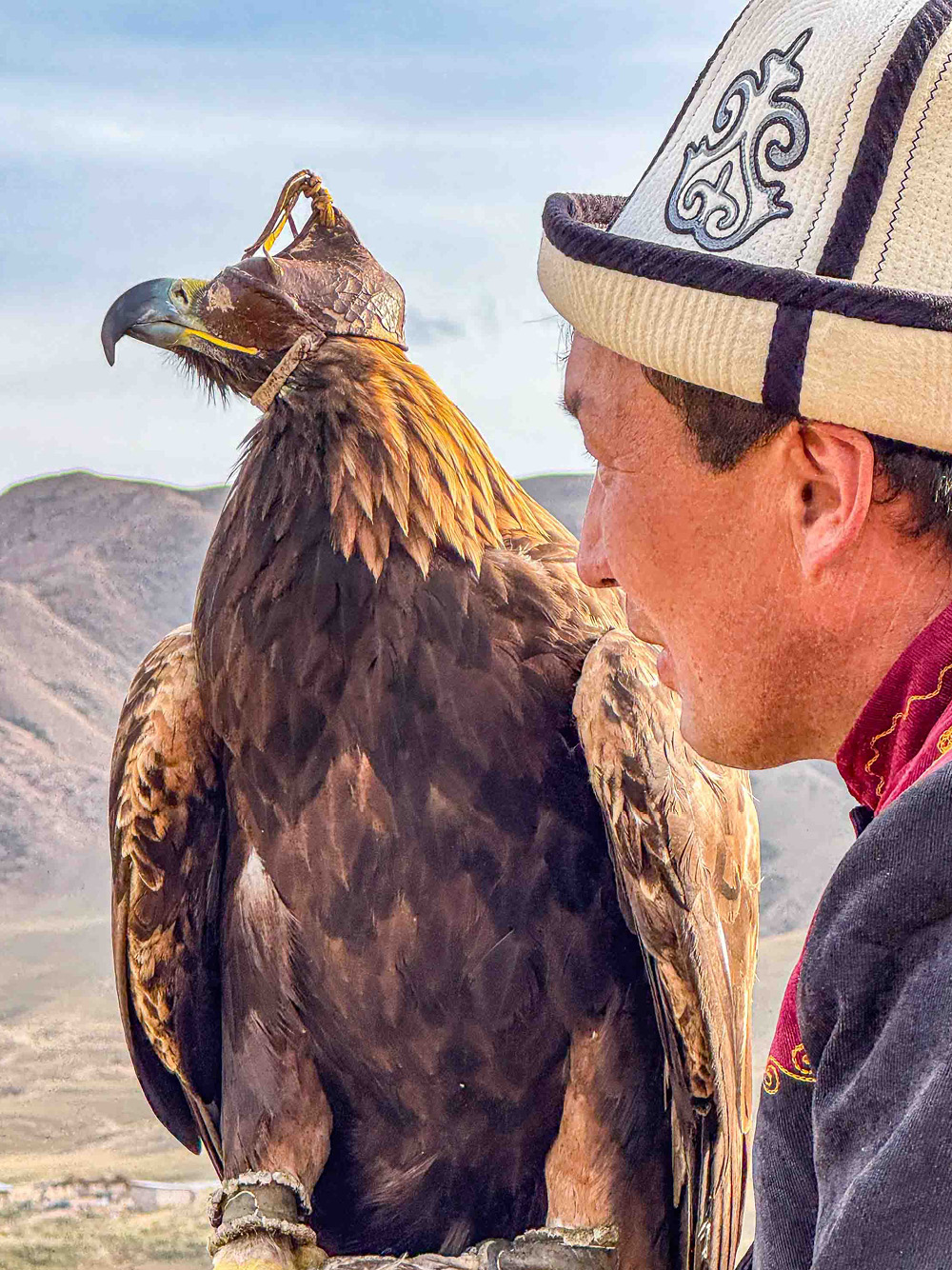
Hooded, the eagle calms down
She gets her prey
The hunter we’re visiting in this broad valley surrounded by distant hills has trained his nine-year-old golden eagle since she was a fledgling. I admire her savage beauty as she rocks back and forth on her trainer’s gloved arm, keenly searching the distance for motion. Hunter holds firmly the two rawhide straps attached to her ankles as a precaution to her unexpected movements.
He places a leather hood, called a tomogo, over her eyes and she settles down. The trainer’s son approaches and transfers the bird from his father onto his own gloved arm. He climbs onto his horse and heads up to the top of a distant steep hill. At the peak, boy and bird are outlined against the clear sky.
The hunter fastens an indescribable piece of animal to a twenty-foot rope; he climbs on his horse, tying the other end of the rope to his saddle.
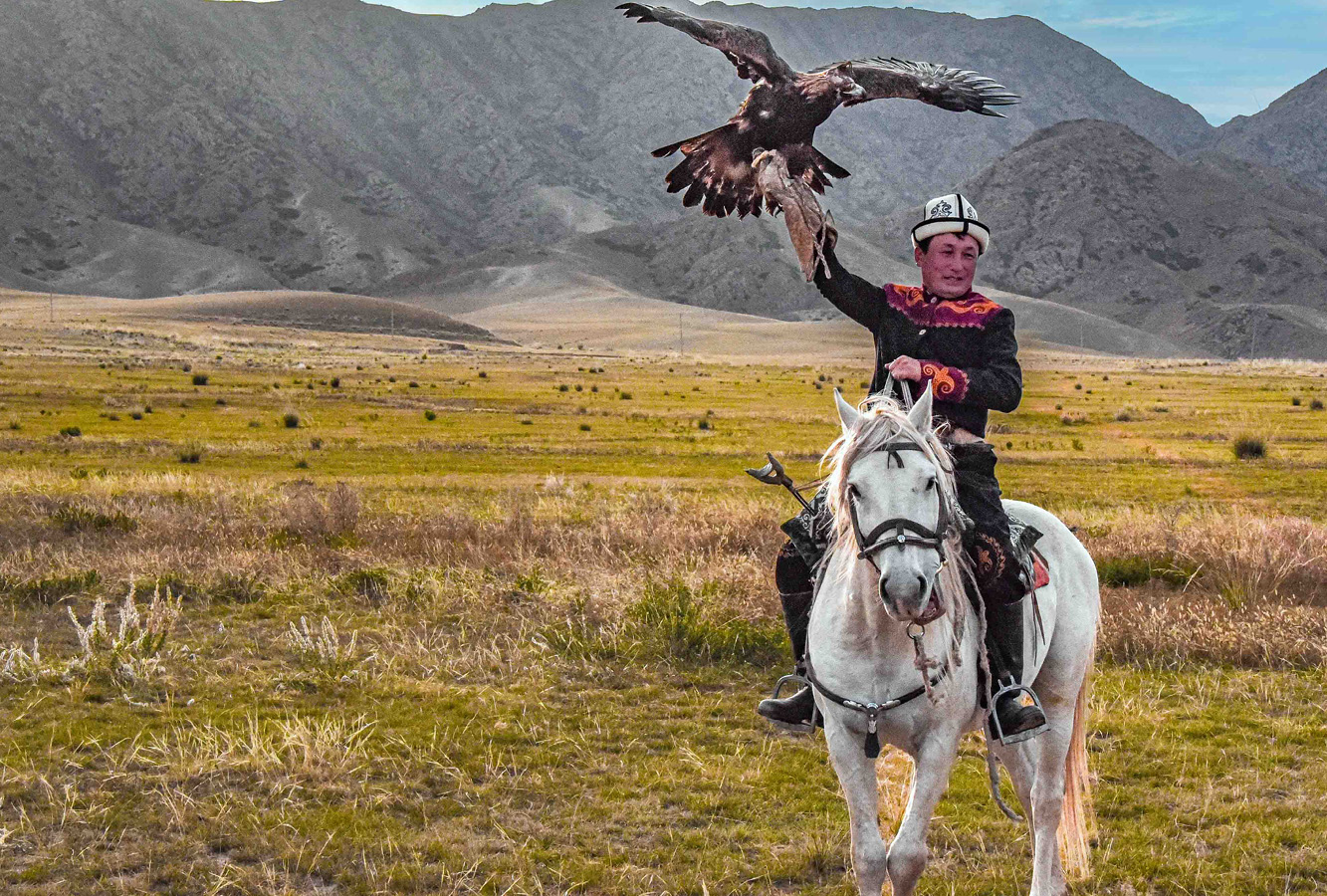
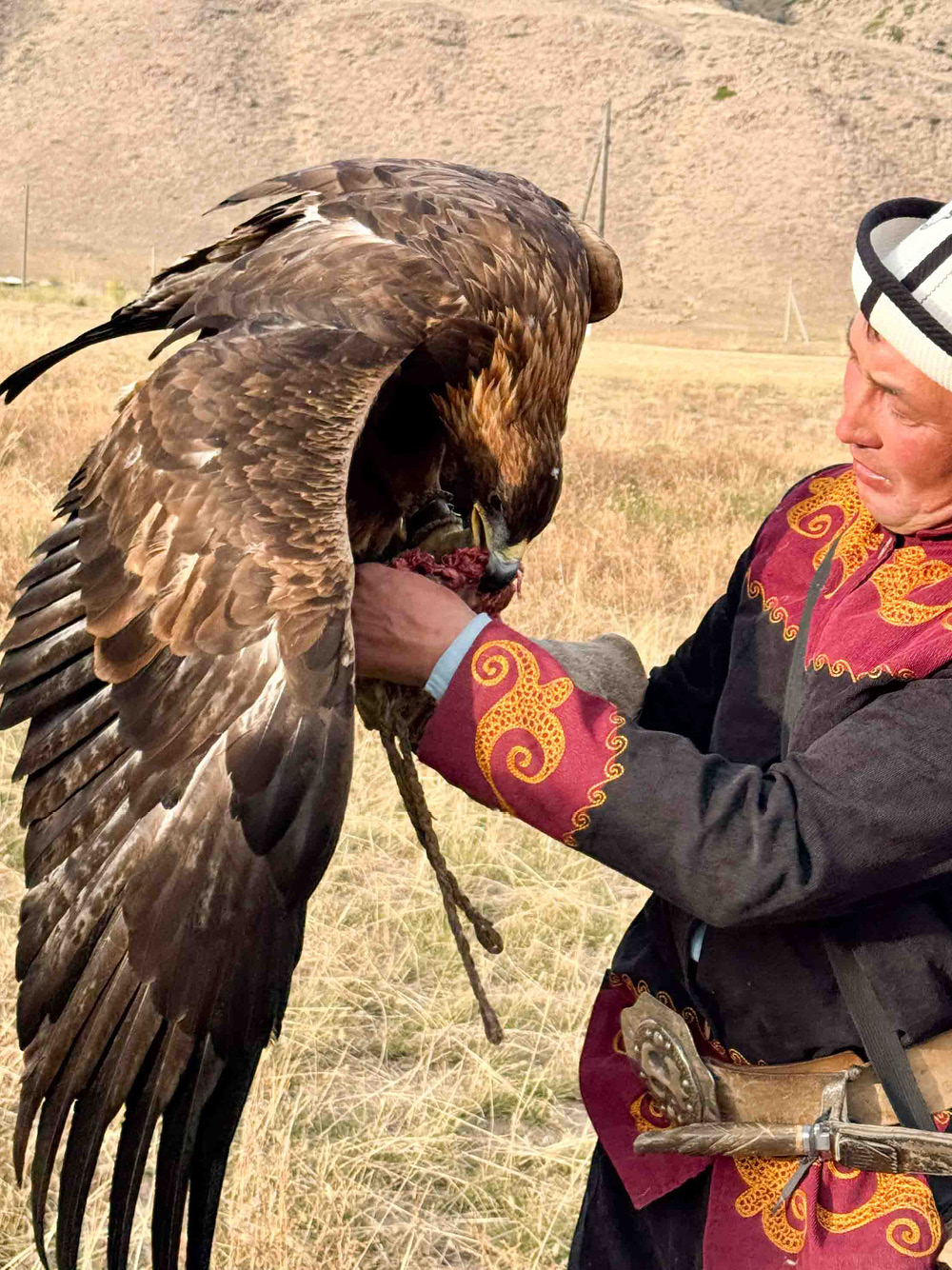
He waves his hand, and his son removes the hood from the eagle’s head. The hunter urges his steed forward, dragging the meat and fur decoy slowly along the ground. At first, I can’t see her take flight; seconds later, her outline appears against the sky as she soars towards us, then swoops to the ground, pouncing on the “kill.” The hunter approaches the bird and allows her to devour the meat from his hand.
I learn that eagles don’t immediately rip into their prey. They grasp the victim’s neck and body, using their talons to suffocate the victim. Once the body is still, they feed, or in the case of eagle hunting, present the lifeless form to the hunter. The raptors receive a chunk of body as a reward for a successful hunt. Eagles will eat most parts of their prey; for instance they will swallow fur and ears of rabbits, then regurgitate what’s indigestible.
Rabbit for dinner, anyone?
For the next part of the demonstration, another young man carries a fidgety rabbit onto the field, as the son and hooded eagle ride up the hill again. As the rabbit is placed on the ground, the son removes the eagle’s hood. Suddenly she’s aloft and takes a direct flight path to the hopping bunny. Talons extended, she lands on the unsuspecting rabbit. Tussling bird and rabbit merge in a blur. Suddenly, the bunny leaps away with several hops. On the ground, the eagle is less adept and can’t catch up to the rabbit. The hunter calls an end to the staged hunt, and bunny will live to hop another day.
The hunter motions for me to join him. He gives me a hunting coat and hat, and I slip into a leather glove, extending my arm. The twelve-pound bird hops onto my arm, grasping the glove with her talons. I’m awestruck. It’s practically a spiritual experience to be so close to raw, wild beauty, knowing that she has the upper hand with me for the moment if she chose to attack. Of course, she’s a perfect lady. After a brief photoshoot with the iPhone, I happily return her to her trainer, a grateful tourist for the privilege to participate in this performance.
the eagle feasts from the meat of the decoy
Even a rabbit’s ear disappears into the eagle’s throat
It’s a three-creature team: eagle, horse, and hunter
What’s the future of eagle hunting?
Nowadays, about forty to fifty master eagle hunters are left in Kyrgyzstan. They keep the custom alive as a proud symbol of their culture and pass on the skills and practice to willing sons and relatives. A significant source of income these days comes from staging performances for tourists like us. This practice presents a dilemma in formerly nomadic communities, whose members see their revered cultural customs served up as entertainment. On the other hand, the performances can generate a nice income to supplement earnings from their small family farms.
Eagle hunters and their birds also look forward to competing in the biennial World Nomad Games with hunters and their birds from all the Stans, Mongolia, and from up to 100 countries. Other competitive games include horseback archery, wrestling, games with goat carcasses, and other nomadic cultural performances, keeping long held traditions alive. You can catch the next international event in 2026 in Kyrgyzstan.
UNESCO named eagle hunting, under the rubric of falconry, as an Intangible Cultural Heritage of Humanity.
Her golden crown and dark chocolate brown feathers accent the bird’s majesty