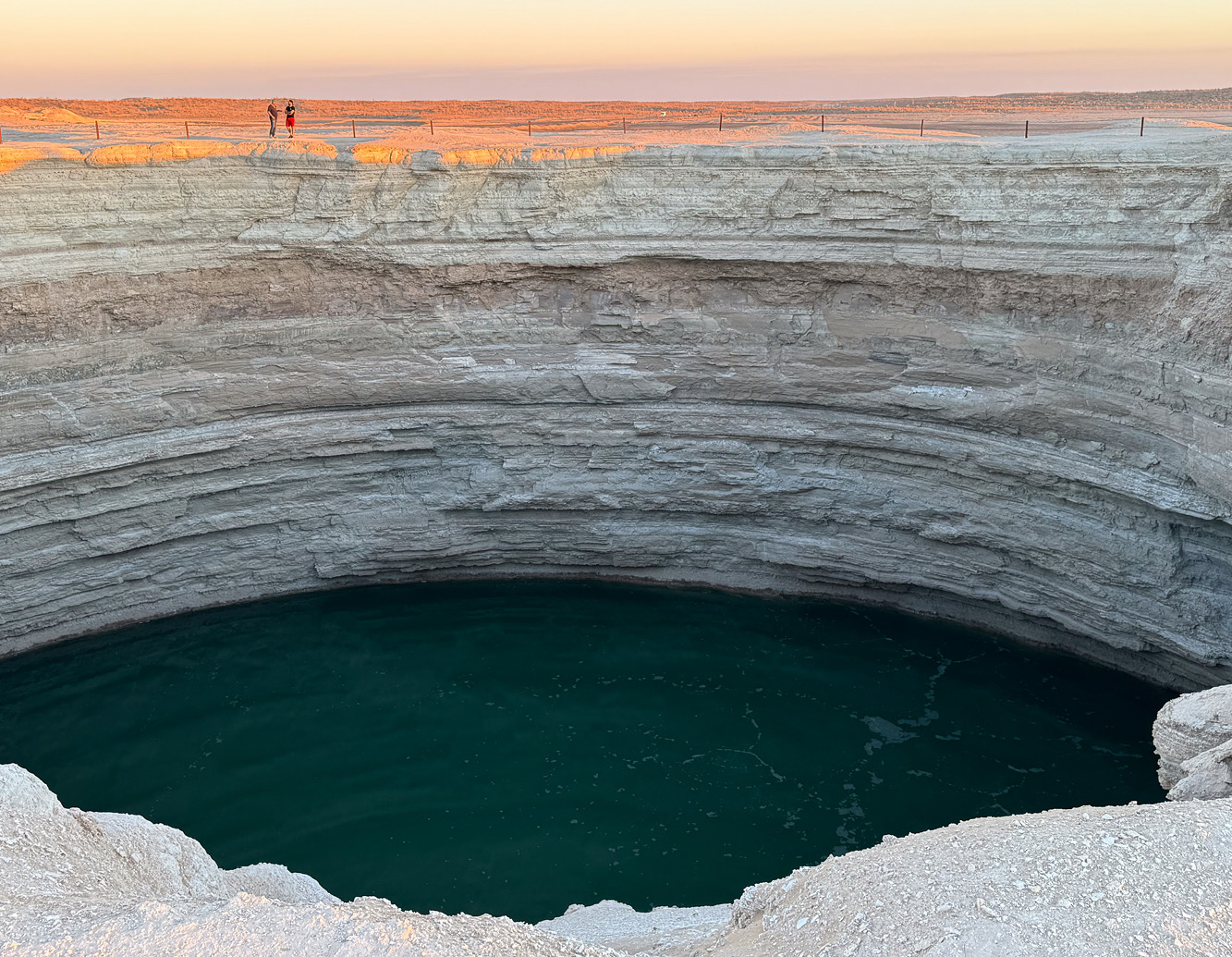
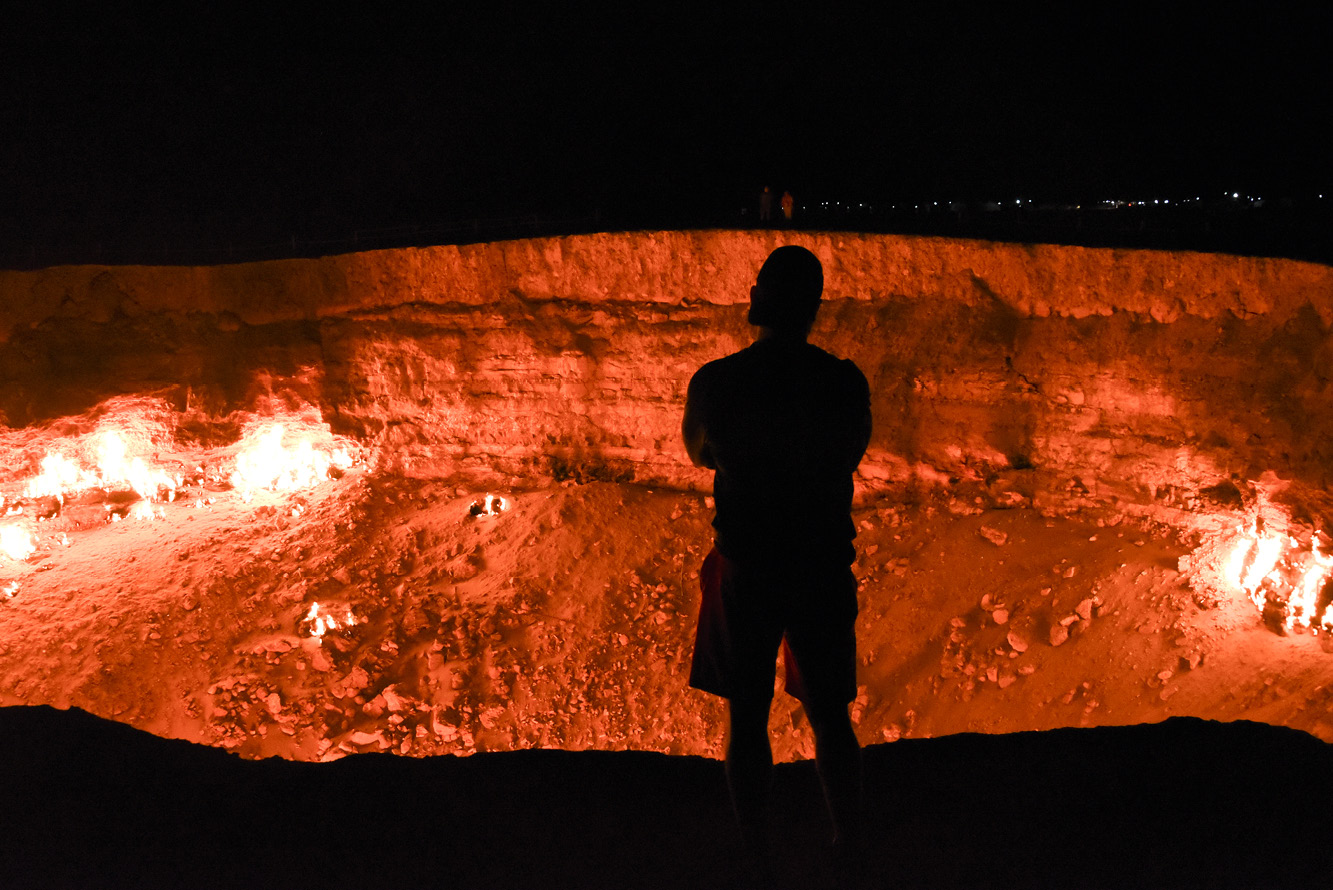
You’ll find it on lists of “The Oddest Places in the World to Visit.” The gigantic hole in the desert floor is on fire, and it’s been burning continuously since 1971. Measuring 200-230 feet in diameter and about 100 feet deep, the “Gates of Hell” presents a spectacular, supernatural scene at night, an eerily glowing, gaping maw against the surrounding pitch black Karakum Desert in Turkmenistan.
Turkmenistan possesses the fourth largest natural gas reserves worldwide, and a substantial portion lies underneath Karakum Desert. In 1971, Soviet geologists were drilling to find new pockets of gas when the roof of a huge cavern collapsed. Toxic gases leaked out into the atmosphere, endangering residents of the nearby village of Darvaza, posing an environmental crisis. So geologists set the gas on fire, assuming it would burn itself out in a few weeks or months. Fifty-four years later, its flames continue to attract visitors to see the phenomenon.
Should we or shouldn’t we?
Of course, I wanted to experience this in real time, and the Crater landed on the list of “must-see” sites on our three-week Central Asia trip. But once we researched the site, we discovered that visiting this site required a four-and-a half hour road trip from our base in Ashgabat, the country’s capital.
We learned that a couple of nearby yurt camps accommodated overnight guests, but our travel agent warned us about the very basic amenities available there. The camps didn’t seem to meet our minimum requirements, so we opted for the demanding round trip visit in one day. Despite a grueling experience riding in the back seat of a Toyota Camry for nine hours, we decided we made the better choice once we saw the yurt camps up close, with their shared squat toilet facilities. Maybe thirty years ago…
We’re off to the “Gates of Hell”
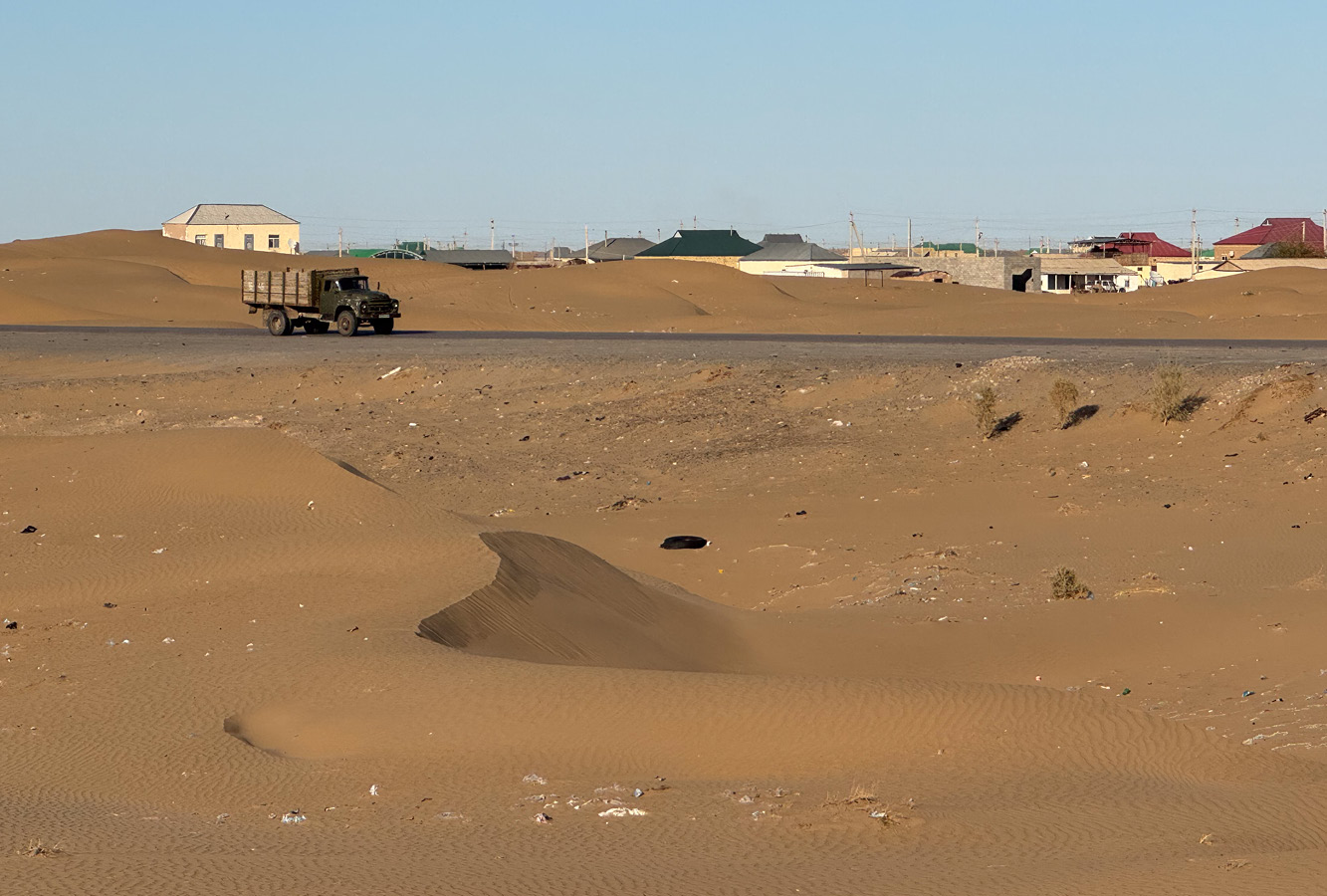
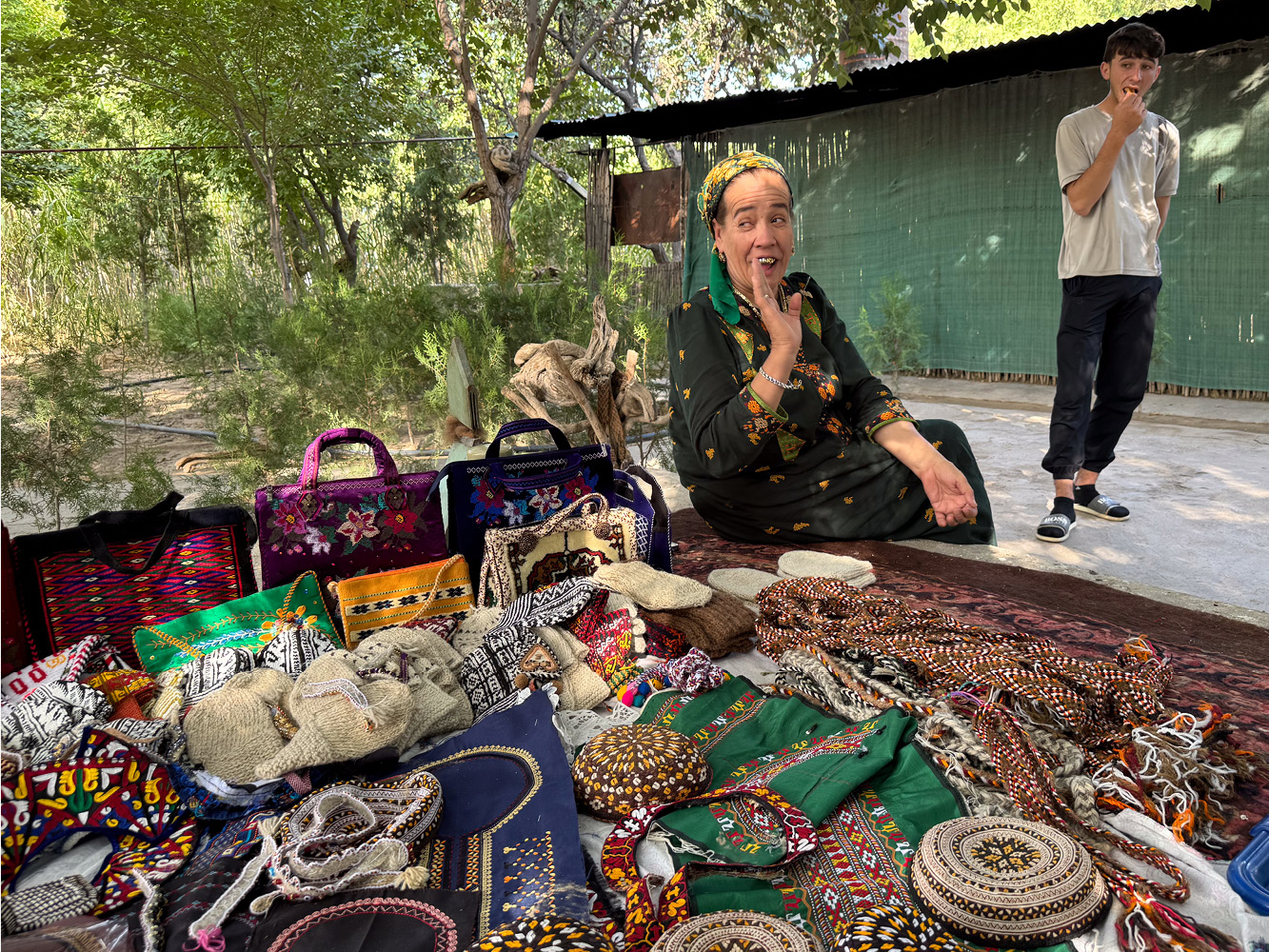
Our guide Serdar and his driver picked us up at our Ashgabat hotel mid-afternoon and headed north. For the first two hours, the road was adequate, the driver maneuvering around potholes and broken sections. Along the way, Serdar took us to a hardscrabble village, the roofs visible behind a sand dune, to visit a local woman with a compound of a few yurts for guests, assorted grazing animals and two small camels, and a hot oil-filled pot for frying paper thin wheat snacks she served. She also sold locally made crafts and. trinkets for tourists. I felt the weight of poverty that these villagers endured, and I was relieved to get back on the rough road.
We approached a checkpoint with fences on either side that signified the entrance to Karakum Desert. And that’s where I experienced the worst roads I’ve ever traveled on. Originally built as a four lane road, in each direction only one lane was usable. Drivers needed to use both lanes to switch back and forth as chunks of road blocked the path and macadam disappeared. So bad were conditions that over time trucks and cars created bypasses into the desert on either side of the main road to avoid impassable areas. Swerving back and forth tested my usually buoyant sense of adventure. The road should be renamed the “Highway to Hell.”
Finally, after another two-and-a-half hours, the driver exited onto a barely recognizable vehicle path over sand dunes for a mile. We crested a sandy hill, and the fiery phenomenon greeted us.
Hell Hath No Fury
The sun sat on the horizon, poised to vanish for the night. The glow from the crater pulsated in the shimmering air, beckoning a closer inspection, as it heated my face. I stood behind a safety fence and peered over the edge. Behold, a demonic, hellish scene! Fires burst out of the walls of the crater, white hot flames licking the superheated air above them. Mesmerized, I watched visitors walk around the fiery pit, some ignoring the safety fence and venturing too close for comfort. With up to 1000° C temperature at the crater’s bottom, a slip or stumble means instant incineration.
We drove to one of the yurt camps to have a barbeque dinner. As night fell, we returned to an even more vivid scene, the desert a black void surrounding an orange-white hot cauldron of burning gases.
We hit the road a little after 9:00 p.m., or more truthfully, the road hit us, as the driver swerved and jostled the Camry over the terrain. Out of the darkness a camel wandered across our path, and we narrowly missed it. I nudged our guide to make sure the driver didn’t fall asleep, as the straightaway road jostled us back to Ashgabat. We fell into our hotel’s bed just after 2:00 a.m.

A few years ago, the government undertook a project to extinguish the fires by drilling wells nearby to capture methane gas that the ground emitted. The gas crater’s existence threatened to hamper continued development of other natural gas fields. Authorities declared two-thirds of the fires extinguished, with plans in the works to shut it down completely. Yet the “Gates of Hell” continues to glow brightly, and it remains a top tourist attraction for the country.
I’m satisfied we saw it, but the one-day round trip was brutal. Yet, if roughing it for a night in a yurt isn’t a game changer so you could return to Ashgabat the next day, then by all means, enjoy this incomparable experience. Hurry, though. Someday they’ll be successful in turning off the burners.

If You Go
Turkmenistan, until recent years, was a closed country, with rigid visitation restrictions. It’s relaxed those rules, now beginning to encourage tourism.
A visitor needs a Letter of Invitation to be able to apply for a visa. A sponsor, or in our case, the travel agent, applied for the LOI on our behalf, which we carried with us into the country to get the visa. Read about requirements and process for entering the country. Once there, it’s a very safe place to visit. Turkmenistan’s authorities claim there’s no crime in their country, since punishment for even slight transgressions are severe.
AIR & CAR
Turkish Airlines is the only major international airline flying from Istanbul direct to Ashgabat , in addition to Turkmenistan Airlines.
Your sponsoring travel agency will make those arrangements.