Above image: Four men, including our guide Alex in the yellow jacket, carry me down the hill in a blanket. My sneaker pokes out near the bottom of the rescue scene.
A Travel Memoir About Risk, Rescue, and Why Preparation Matters
“CRACK!!”
The sound stunned me as the left side of my body slammed into the boulder. I knew immediately that something had broken. I screamed. Our guide, Alex, tried to help me stand, but sharp pain shot through my leg. “I can’t walk!” I cried. He gently lowered me to the ground. “I’m going for help,” he said in a soothing voice, trying to calm me. Then he turned and disappeared down the gravelly path around a bend in the trail.
Alone, my mind careened from one fear to the next. How would I get down? The slope was steep, the gravel loose, and the sun already dropping. What if I were stranded here all night? Fear gripped me.
I could see people walking on rock formations in the distance, specks of hikers stepping along the ridges. As I stared into the vast open space, time seemed to slow. An odd clarity settled over me.
Two couples rounded the bend below me and climbed toward me. They stopped, alarmed, and asked if they could help. “My guide has gone for help,” I said, my voice trembling. As they continued their ascent, panic choked me.
Back on the canyon floor, Rick was studying colorful rock formations, pitted and channeled by millions of years of erosion. A scream broke his concentration. A long minute passed before Alex rounded an outcropping, trotting and sliding down the gravelly trail. His hurried report stunned Rick. Alex then rushed to the park entrance to seek help, leaving Rick worried and helpless.
Fifteen minutes passed. Or was it two hours?! I tried to slide down on my right side and rump, managing about ten feet before the trail became too steep to continue. Then I heard voices approaching. Was it my rescue party?
Following the Ancient Silk Road Into Kyrgyzstan
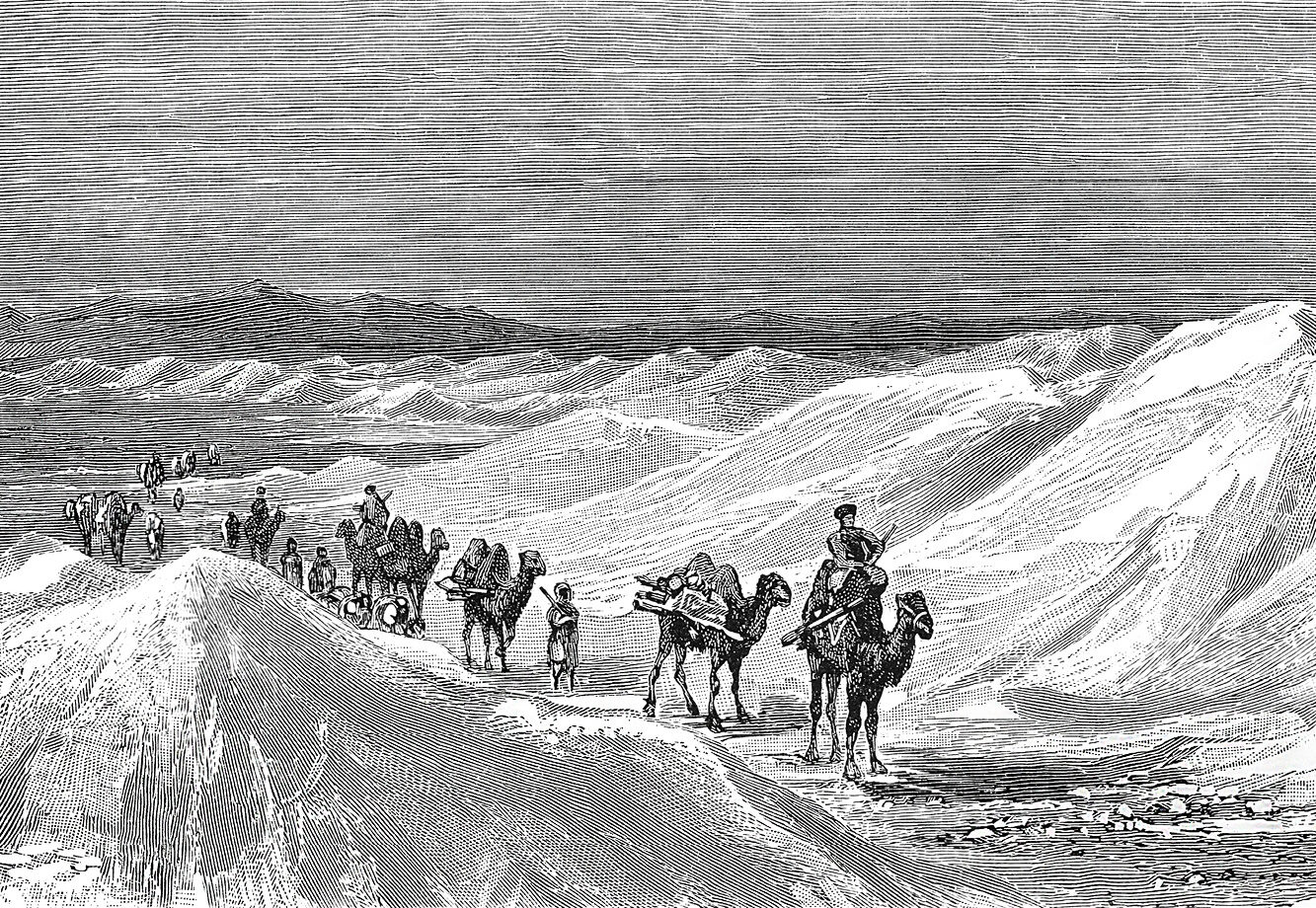
Rick and I were nearing the end of a nineteen-day adventure exploring the glorious vestiges of the ancient Silk Road that once ran from China to Rome. It was Day Sixteen, and we were hiking in remote Fairy Tale Canyon on the south shore of Lake Issyk-Kul in Kyrgyzstan, a stunningly beautiful and rugged country in eastern Central Asia. The day before, we had traveled five hours from Bishkek, the capital, to visit nomadic eagle hunters whose golden eagles still hunt live prey. We spent the first of two nights in a yurt camp along the lake’s shore just outside the small ecotourism town of Bökönbaev.
Earlier that day, our Russian guide Alex first took us to Barskoon Gorge, where we climbed a mountainside to the “Beard of the Wisemen” waterfall. After lunch, we entered Fairy Tale Canyon, a rare geological wonder shaped by earthquakes millions of years ago. Layers of sandstone created a dramatic landscape of orange, yellow, and purple rock rising in jagged outcroppings. Visitors climb these hills, following gravelly trails through the scrub.
Once in the park, I immediately wanted to climb a hill. Rick declined. “Go ahead. I’m staying right here.” Alex and I took off up a nearby path. After climbing for fifteen minutes, we reached the flat summit. The view opened onto a panoramic moonscape, its bands of color glowing in the late light. I spotted other hikers on distant formations. After snapping several photos, we began the descent. The path seemed much steeper going down, and Alex advised me to turn sideways and crab-walk across the crumbly trail. I took one step, and my foot landed on a patch of loose pebbles. That’s when it happened.
Heroes Arrive to Rescue Me
Alex appeared, blanket in hand, with our van driver and two other men. They lifted me onto the blanket. Excruciating pain shot through my leg, but it was not the moment to complain. Each man grabbed a corner, and they began the careful descent along the narrow path, trying not to stumble or drop me. At one point, the man near my head slipped on the gravel and slid underneath me. We stopped until he recovered, then continued downward, my body occasionally scraping the ground and rocks.
We reached the canyon floor. I will never forget the look of horror on Rick’s face when he saw me crumpled inside a blanket and writhing in pain. I felt terrible for putting him through that anguish, especially knowing, in hindsight, that I had taken a real risk. The rescue party then carried me another quarter mile, still in the blanket, to the park entrance where our driver had left the van.
There was no cell service in this remote area. After settling me on a platform with Rick, Alex and the driver headed back to the restaurant where we had eaten lunch, which had a signal, to call Bökönbaev for an ambulance. I took four ibuprofen from my daypack, and the next hour crawled by as Rick tried to calm me down. When the ambulance arrived, the emergency medical team pulled out a stretcher and carried it to me. One EMT approached with a hypodermic needle, plunged it into my arm, and emptied its contents.
Almost immediately, my body relaxed and the tension eased. Strapped into the litter and loaded into the ambulance, I headed for the town clinic. As the only person fluent in both English and Kyrgyz, Alex rode with me and facilitated everything over the next several hours. Rick returned to the yurt camp with our driver to retrieve and repack our four large suitcases and check us out.
As dusk fell, the ambulance reached the clinic an hour later. The EMTs unloaded the stretcher and carried me through a dark labyrinth of hallways to the x-ray room, sliding me onto a cold metal table. When they tried to cut off my jeans, I stopped them. (They were just getting broken in.) The images confirmed a fracture at the top of the femur, where it fits into the hip socket. Meanwhile, Alex contacted a hospital in Bishkek to request an ambulance to transport me to the capital and arranged my admission to a private hospital. “I will not permit you to go to a community hospital,” he said. I could only imagine what the public hospital was like.
Our driver brought Rick and our four suitcases from the yurt camp to the clinic, where he joined me in a poorly lit hallway to wait for the ambulance. Around 2:00 a.m., the EMTs loaded me onto a stretcher again and into the ambulance for the five-hour trip over pothole-ridden roads. Alex rode with me to translate and help coordinate care, while Rick and our luggage traveled separately with the driver, who spoke not a word of English.

A Crash Course in Bishkek Hospital Culture
The ambulance pulled into the hospital around 7:00 a.m. At first, I was placed in the trauma ward, a disturbingly noisy space where other patients voiced their pain through the night. The head doctor spoke a little English; the rest of the staff spoke Russian and Kyrgyz. Between sign language, Google Translate, and patience, we managed. Later, I was moved to a room with two other men, which was much calmer.
Once Rick arrived, he and Alex met with hospital administrators and paid a $500 admission fee to cover basic expenses until the insurance payments began. Before leaving home, we had purchased a comprehensive policy from Faye Insurance. Once Rick notified the company, its agents responded quickly and took over the financial and logistical arrangements for the rest of the ordeal, covering all but a few minor expenses.
Bishkek was not the right place for surgery; the necessary level of medical sophistication was not guaranteed. Faye’s medical contractors began arranging air transport to three-year-old Memorial Hospital in Istanbul’s Şişli neighborhood for the procedure. I spent three nights in the Bishkek hospital while a medical jet was rerouted to Central Asia to carry me to my next destination. Rick stayed at a nearby Radisson. The days crawled by, though I was kept semi-sedated. Despite the communication challenges, the Kyrgyz and Russian staff were caring and attentive.
During my stay, I developed two urgent needs that I reported to the doctor. First, I was bloated and in significant stomach pain, and I could not eat. Second, after four days without a shower, I needed help bathing. Soon, a tall, broad woman in dull green scrubs appeared beside my bed carrying a bulging hot-water bottle with a hose and nozzle suspended from an IV pole. I knew what was coming. She spoke Russian brusquely and motioned me to turn onto my side. The procedure accomplished its intended effect. What a relief.
She later returned with a basin of soapy water and a washcloth and proceeded to clean every inch of me. I had to let go of any remaining shred of modesty. When she finished, I patted her arm in gratitude. She leaned close, held up both hands with all ten fingers extended, and made clear that this service carried a fee. She waited until Rick arrived the next morning to be paid. Even so, it was a well-spent ten dollars.

We Fly to Istanbul for Surgery
The medical jet arrived. The EMTs secured me tightly to a stretcher before loading me into the ambulance. Alex said his goodbyes; he was off to meet a new tour group. After a brief ride to the airport, six men hoisted me, feet first, up the steps of the jet, my head hanging downward. A doctor and a nurse strapped the stretcher to an interior wall. We took off around 2:00 a.m. Both medical attendants were German men who volunteered on emergency flights throughout Europe and Asia. Medical equipment lined one side of the cabin. The nurse asked me to recount the misadventure so far, and we talked about our mutual love of travel before I drifted off for the rest of the flight.
Five hours later, I was taken off the plane and placed in a waiting ambulance for the short ride to the airport gate, where I had to clear immigration. An ambulance attendant took my passport and disappeared. A few minutes later, a Turkish immigration official briefly opened the rear door—presumably to confirm that I matched my passport photo. Then I was transferred from one ambulance to another, since I was now leaving international airport space and officially entering Türkiye.
When the ambulance arrived at Memorial Hospital, staff immediately whisked me to the x-ray room and confirmed two fractures and a hairline crack. They settled me in a private room with a picture-window view of Sultanahmet, Istanbul’s old quarter, where we had stayed three years earlier. A crushing anxiety lifted. Over the next ten days, I realized how fortunate I was to land in a well-run, professional facility with ample resources and skilled staff. Istanbul, in fact, has an excellent reputation for medical care.
Meanwhile, back in Bishkek, Rick learned he could not travel with me on the jet. The plane was too small to accommodate another passenger along with all our luggage. Faye’s travel agents arranged a later Turkish Airlines flight for him that morning, and a helpful taxi driver assisted him as he wrestled our bags through check-in. Once in Istanbul, he checked into the Novotel and then came straight to the hospital.


A Compassionate Stay at Memorial Hospital
Dr. Aydin spoke fluent English, though a woman accompanied him to translate the more technical details of the surgery. Energetic nurses, aides, and orderlies—many equipped with translation tools—made me comfortable and prepared me for the procedure, which was scheduled two days later to allow certain medications to clear my system.
In the meantime, “Six Degrees of Separation” worked its magic behind the scenes. One of Rick’s relatives had a close college roommate who had married a Turkish woman from a prominent Istanbul family with ties to the city’s hospital world. Through this network of connections, my surgeon was contacted by another medical professional who knew him and told him that his American patient was an important friend of the family. “The eyes of Istanbul are upon you.” On the day of surgery, Dr. Aydin explained the procedure and ended with a dry smile: “I received a phone call.” For the next ten days, he and the staff took attentive care of me.

I Make a Hospital Friend
I developed a special rapport with one orderly in particular. She dressed differently from the other staff, wearing traditional Muslim clothing while many of the other women wore Western-style scrubs. She wore a wheat-colored hijab and a long, loose robe. Her face had a grandmotherly warmth that made her seem older than me, though she probably wasn’t. During her shifts, she sometimes stopped by twice, checking on me and fussing over my comfort. She straightened my bedding, made sure I had fresh water, and often patted my arm before leaving.
She spoke no English, but that did not stop her from talking to me as if I understood every word. With the help of gestures, I talked back. One day, she pulled out her phone to show me photos of her son, his wife, and her grandchildren, counting out their ages on her fingers. She always lifted my spirits, and we greeted each other warmly. Another day, she wheeled me into the room’s wheelchair-accessible shower, put on a clear plastic raincoat, and gently cleaned me up. It was yet another humbling moment on this trip.
Home Again, With a Long Rehabilitation Ahead
Three days after surgery, during which surgeons inserted an eight-inch pin and two screws, the staff had me stand and circle the nurses’ station several times with a walker to prepare for discharge. Several more days passed before Faye’s travel team could arrange the most convenient flights to Philadelphia with the briefest layover. Eleven days after admission, we left Istanbul on British Airways, with Rick pushing my wheelchair. A kindly flight attendant, noticing my discomfort, insisted I have two vodkas to relax. It did the trick. After a short stopover in London, we landed in Philadelphia.
Two weeks had passed between the accident in Kyrgyzstan and our arrival at our front door, after which a demanding course of physical therapy began. At first, I was discouraged by the slow progress, but my Philadelphia surgeon reminded me that it would take a full year of focused rehabilitation to regain my pre-accident strength and mobility.

What the Experience Taught Me
The months of physical therapy and limited activity gave me time to think about what this ordeal meant to me. What did I learn from it? How had it changed my perspective on life? And would I travel again?
- The recovery process taught me patience, a trait that does not come naturally to me. In those early weeks, I had to accept help with even basic tasks, from getting in and out of the shower and bed to being carried down steps in a wheelchair. For someone who is always on the go, I had to learn to slow down; rehabilitation takes time.
- My compassion for people living with permanent physical disabilities deepened; they must navigate the world in ways many of us rarely have to consider.
- From the moment of the accident until I boarded my British Airways flight home, nearly everyone I encountered—EMTs, hospital staff, and taxi drivers—was caring and helpful. The experience reminded me that, across cultures and distances, people often share a basic sense of decency and kindness.
- Of course I will travel again! I am driven by a restless curiosity to seek out places and cultures that expand my understanding of the world.
- Still, falling down a steep hill introduced a new measure of caution into my travel bravado. I will think twice before taking on an activity that carries a real chance of injury.
My Advice: Buy Travel Insurance
Accidents can happen to anyone at any time, whether you are traveling abroad or simply going about your routine at home. Most of us carry medical insurance for everyday health needs and unexpected mishaps. But too many travelers skip travel insurance when heading overseas, assuming nothing will go wrong. My experience showed how costly that assumption can be. They are taking a serious and unnecessary risk.
I cannot say exactly what the total bill was for surgery, hospital stays in Istanbul and Bishkek, the medical jet, ambulances, and airfare home, but even a rough estimate makes clear how financially devastating it could have been. We had purchased comprehensive insurance that included emergency evacuation because it seemed like sensible protection. We never expected to need it. Then the accident happened. Working closely with Rick, Faye Insurance responded quickly, and its network coordinated the arrangements that brought us safely all the way home.
Here is my advice: research highly rated travel insurance providers and read reviews from travelers themselves. Look for companies with a strong record of prompt payment and minimal disputes over claims. Treat the cost of travel insurance as part of your travel budget, not as an optional extra. You only need it once to understand its value. Travel insurance is not an add-on; it is essential protection. After this experience, we will never leave home without it.