

Thailand’s Buddhist White Temple Dazzles the Senses
Our van pulled away from Thailand’s beautiful northern city, Chiang Mai, on the pot-holed road heading towards the neighboring city, Chiang Rai. At our midday lunch stop for a Thai buffet, a large billboard advertised Cabbages and Condoms, a Bangkok restaurant that promoted family planning. (It must be in a theme category all by itself.) The billboard was a harbinger of sorts to the surprising spectacle awaiting us.

Turda Salt Mine: The Underground, Romanian Amusement Park
In today’s colloquial parlance, the phrase “salt mine” conjures up unpleasant or even grueling work. “Back to the salt mines!” goes the phrase as one returns to work after a break. So you can imagine my puzzled reaction to see the Turda Salt Mine near the top of our Romanian travel itinerary.

“Faces Are Windows into Cultures Around the World” a Talk with the Philadelphia Society of Photographers
Watch a virtual presentation of my work for the Photographic Society of Philadelphia. My talk, titled “Faces are Windows into Cultures Around the World,” uses informal portraits of people I’ve taken around the globe to highlight local architecture, religion, customs, and a sense of place.

Visiting Évora’s Chapel of Bones
“What are we going to do with all these bones?” Sixteenth century Franciscan friars must have asked themselves this challenging question once the bones were dug up from cemeteries and local churchyards throughout Évora, Portugal. The bones and skulls of thousands of dearly departed must have created quite a huge pile. How did this situation come to be? And why here? A look at Évora’s history reveals the answers.

The Spring Garden Pops with Chartreuse
Six different species of chartreuse plants glow in the garden right now: a small tree, a shrub, two perennials, and two ground covers. Altogether, they make the garden pop. Each one attracts the visitor’s attention to admire its form, distinctive leaves, and in some cases, dramatic flowers. They brighten spaces, and by their presence, highlight their more subtle plant neighbors.

Getting from Here to There: Shakedown in Colombo, Sri Lanka
Just over two years later Rick and I joined Eva and Suresh, our Indian travel pals, for a month in their home country, including a nine-day visit in the middle of the journey to the island country of Sri Lanka (formerly Ceylon), located off the southern tip of the subcontinent to the east. Aware of the 30-day restriction for re-entering the country, we visited the Indian Embassy in New York City a month before our U.S. departure

How to Choose a Local Travel Agency
When we pack our bags and hit the trail, Rick and I enjoy traveling by ourselves, or sometimes with longtime travel buddies Eva and Suresh. A lot of preparation goes into a travel adventure long before we board the plane. On trips to destinations that are culturally more familiar, like North America and most of Europe, we do our own trip planning––what to see, how to get there, and where to sleep. In non-Western countries, private tour companies provide us with professional

El Peñol Erupts from Colombia’s Landscape
El Peñol, a 656-foot granite rock, juts out of the earth. No ordinary rock, El Peñol, a Colombian National Monument, attracts thousands of people daily, many who climb the 708 steps for spectacular views of the region. On its top, vendors sell handicrafts, trinkets, and tee-shirts. One pays for the privilege of experiencing a panorama of the countryside with about a five-dollar admission fee at the bottom of the stairs.

Guatapé, Colombia Embodies an Explosion of a Crayola Crayons Box
Originally a farming town, Guatapé’s future changed forever with the construction of a hydroelectric dam in the 1970s that catapulted the town’s importance as the chief electric production center in the country. The dam created an endless network of interconnecting lakes, with hotels, exclusive homes, marinas and other recreational facilities. At the same time, it secured Guatapé’s prominence as a tourist destination.

From Colombia to the Philadelphia Flower Show: An Industry is Blossoming
Our first morning in Colombia. We arrived in Bogotá yesterday late afternoon, and we’re ready to explore this capital city with our guide Tomás Vargas. Eleven-and-a- half million metropolitan residents fill an eastern Andean plateau at an 8600-foot elevation, and oxygen-sparce air challenges breathing for us sea level dwellers. Our driver deposits the three of us at the entrance to Paloquemao Market.

Is That a UFO on top of a Bulgarian Mountain? No, It’s Buzludzha!
An unknowing traveler might momentarily imagine an alien space ship as the flying saucer-shaped structure appears at the crest of a barren hill.
Named for the mountain on which it “landed,” Buzludzha (buzz-lud’-ja) served as a grand and lavishly appointed ceremonial headquarters for communist leaders from throughout Bulgaria and the Soviet Union for a brief period of time. Of the six core Eastern European countries comprising the USSR’s “satellite countries” (politically independent, but closely aligned), Bulgaria was considered the closest to the Soviet regime in Moscow.
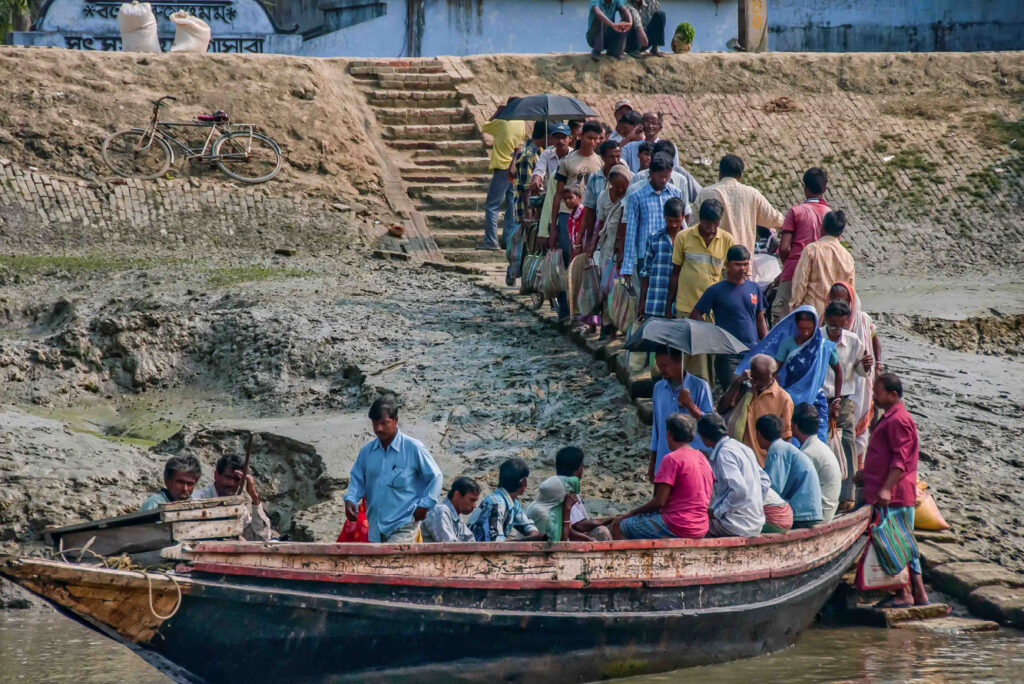
We Sail India’s Ganges River in Search of the Bengal Tiger
India. The name evokes a range of reactions and emotions, from wondrous and magical to crowded, noisy, and poor. From my seven trips to the subcontinent, I can confirm that India exhibits both extremes. I’ve made my own peace with this dichotomy, allowing myself to experience the rich aspects of this 5000-year-old civilization and culture that fall in between the extremes. The sum of these experiences has greatly impacted my life and opened my eyes to a broader way of being in life.

I Fractured my Leg Traveling Central Asia’s Silk Road
“CRACK!!”—The sound stunned me as the left side of my body slammed into the boulder. I knew immediately that something had broken. I screamed. Our guide, Alex, tried to help me stand, but sharp pain shot through my leg. “I can’t walk!” I cried. He gently lowered me to the ground. “I’m going for help,” he said in a soothing voice, trying to calm me. Then he turned and disappeared down the gravelly path around a bend in the trail.

The Netherlands’ Keukenhof Gardens Dazzles with Acres of Spring Blooms
Amsterdam Central Station is a ten-minute walk from Dam Square, the city’s center plaza. Built in 1889, the stately Gothic and Renaissance Revival structure suggests a medieval cathedral, according to civic architects. About 180,000 passengers daily rush through its doors and off to other destinations in the Netherlands and to cities throughout Europe.

Travel Recommendations for Discovering Central Asia’s Spectacular Treasures
Our nineteen-day itinerary to visit Central Asia’s Stans countries proved to be the trip of a lifetime. Every day revealed new cultural experiences that amazed, thrilled, challenged and opened my eyes to an unknown world to me. Excuse the borrowed locational reference, but I felt I was living One Thousand and One Arabian Nights, and every day Scheherazade revealed a fresh magical story.

The Silk Road’s History Conjures Exotic Daydreams
We scheduled our nineteen-day journey to the far-off lands of the fabled Silk Road countries in Central Asia six months before our departure with Bestway Tours and Safaris. But I always begin planning way before that, and this journey required more thoughtfulness about the possible destinations. Part of embarking on any exotic expedition involves researching the internet; reading fiction books, non-fiction articles and guide books; and studying maps to set priorities for sight-seeing. Of course, I learn so much more once I’m on the ground submersed in the local culture. Yet understanding the history of a place and the dynamic influences that shaped it gives context for the real time experiences. Let’s look at what happened there over the centuries.

Kyrgyzstan’s Eagle Hunters Preserve an Ancient Cultural Practice
With four-inch razor-sharp talons, she grasps the leather glove that covers the trainer’s hand and forearm. Her large, protruding eyes peer fiercely, as she swivels her head to survey the surrounding landscape in search of movement along the ground. Her prominent curved black beak ends in a sharp hook, useful for piercing, tearing, and shredding fur, flesh, and bones. Golden brown feathers circle her neck, crown and shoulders, while dark chocolate brown plumage covers the rest of this huge raptor. The majestic golden eagle flaps and spreads her wings, showing off her six-and-a-half-foot span.

All Hell Breaks Loose at Turkmenistan’s Darvaza Gas Crater
You’ll find it on lists of “The Oddest Places in the World to Visit.” The gigantic hole in the desert floor is on fire, and it’s been burning continuously since 1971. Measuring 200-230 feet in diameter and about 100 feet deep, the “Gates of Hell” presents a spectacular, supernatural scene at night, an eerily glowing, gaping maw against the surrounding pitch black Karakum Desert in Turkmenistan.

Tracing the Fabled Silk Road through Central Asia
“You’re going where?!” the familiar question asked by friends and family about out planned nineteen-day trip to Central Asia. “The Stans. The Silk Road countries. You know, the land of Genghis Khan and Marco Polo,” we responded, followed by an attempt to paint a colorful image of this remote, fabled region largely unvisited by Westerners. Central Asia’s vast territory, larger than the 48 contiguous U.S. states, sits south of Russia, north of Iran and Afghanistan, and west of China, with the Caspian Sea roughly forming its western boundary.

Chesapeake Bay’s Tangier and Smith Islands Are Disappearing Slices of Americana
“Island life.” What comes to mind when you hear those words? Warm climes, palm trees, sandy beaches, piña coladas, tropical sunsets? Two inhabited islands in the middle of the Chesapeake Bay in U.S.’s temperate Mid-Atlantic coastal region turn those images upside down. Tangier Island, Virginia and Smith Island, Maryland sit about 12 miles off Maryland’s eastern shore, eight miles apart from each other. Inhabited since the mid-1700s, residents of these communities depend on crabbing, fishing, and oystering for their livelihoods. Successive generations of the first settlers still call those islands their home. And rising sea levels and erosion threaten the future of each community.